
RESIDENTIAL AND COMMERCIAL RENOVATIONS
Transforming Existing Structures with Purpose and Restraint
We often work with existing structures. Some have strong architectural character but no longer function well. Others were altered over time and have lost their clarity. Our role is to reestablish coherence, improve performance, and make the space relevant to its present use.
Each project begins by working with the owner to establish clear goals for how they want to use the structure. We assess what should remain and what should change. We look for opportunities to strengthen the existing structure rather than replace it. When a building has value, whether historic, spatial, or material, we find ways to work with it. When it does not, we refine or rebuild as needed.
Our experience includes residential, commercial, and institutional projects. Some involved full structural reinforcement; others required only interior reconfiguration. In every case, the focus remains on precision, restraint, and long-term performance.
Understanding the Building Before Renovation Begins
Every renovation starts with careful observation. We study how the structure was built, how it has aged, and how it sits within its site. We evaluate mechanical systems, foundations, and envelope performance. We also look at daylight, access, and circulation to understand how people experience the space.
Our work often begins before drawings are made. We collect measurements, document conditions, and coordinate with engineers to determine what is feasible. That information forms the foundation of the design strategy.
A Methodical Approach to Building Renovations
We move through each project using a structured process:
-
Survey and Analysis – Documenting the existing structure, materials, and systems.
-
Concept Development – Establishing spatial priorities, sequencing, and use patterns.
-
Design Integration – Introducing new components that align with the building’s logic.
-
Material Strategy – Balancing existing finishes with new interventions.
-
Execution – Overseeing construction and ensuring the integrity of both old and new work.
This process maintains order across all stages and keeps the project aligned with its intent.
Balancing Past and Present During the Renovation Process
Renovation requires discipline. The goal is not to make an old building look new but to make it work again. We look for qualities worth keeping: proportions, light, texture, or a sense of weight and time. New insertions are designed to clarify, not compete. The architecture should feel continuous even when the materials change.
Minimal Disruption
We coordinate closely with contractors and owners to minimize downtime. Phasing, safety, and accessibility are planned early to maintain continuity of use. We also handle code compliance, permitting, and documentation for historic review when necessary.
Renovation often exposes what was previously hidden. We respond to those discoveries in real time, maintaining the design direction while adapting to the realities of the structure.
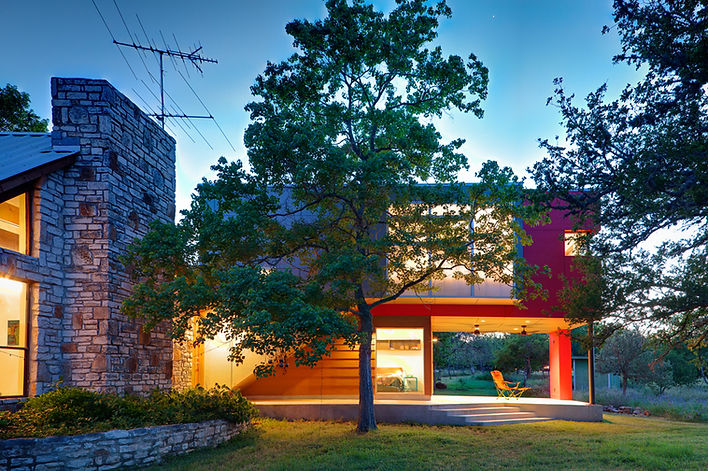
Our renovation work is reflected in two recent projects. At the Ferrand Residence, we clarified a home shaped by decades of additions, preserving its original stone structure while introducing new volumes that engage the hillside site and its historic live oak.
At the Santa Clara Residence, we restored the character of a 1938 home and paired it with a contemporary addition, creating a light-filled spine that connects garden, entry, and upper-level spaces. Both projects demonstrate a disciplined approach: keep what matters, refine what doesn’t, and let old and new support one another.

